
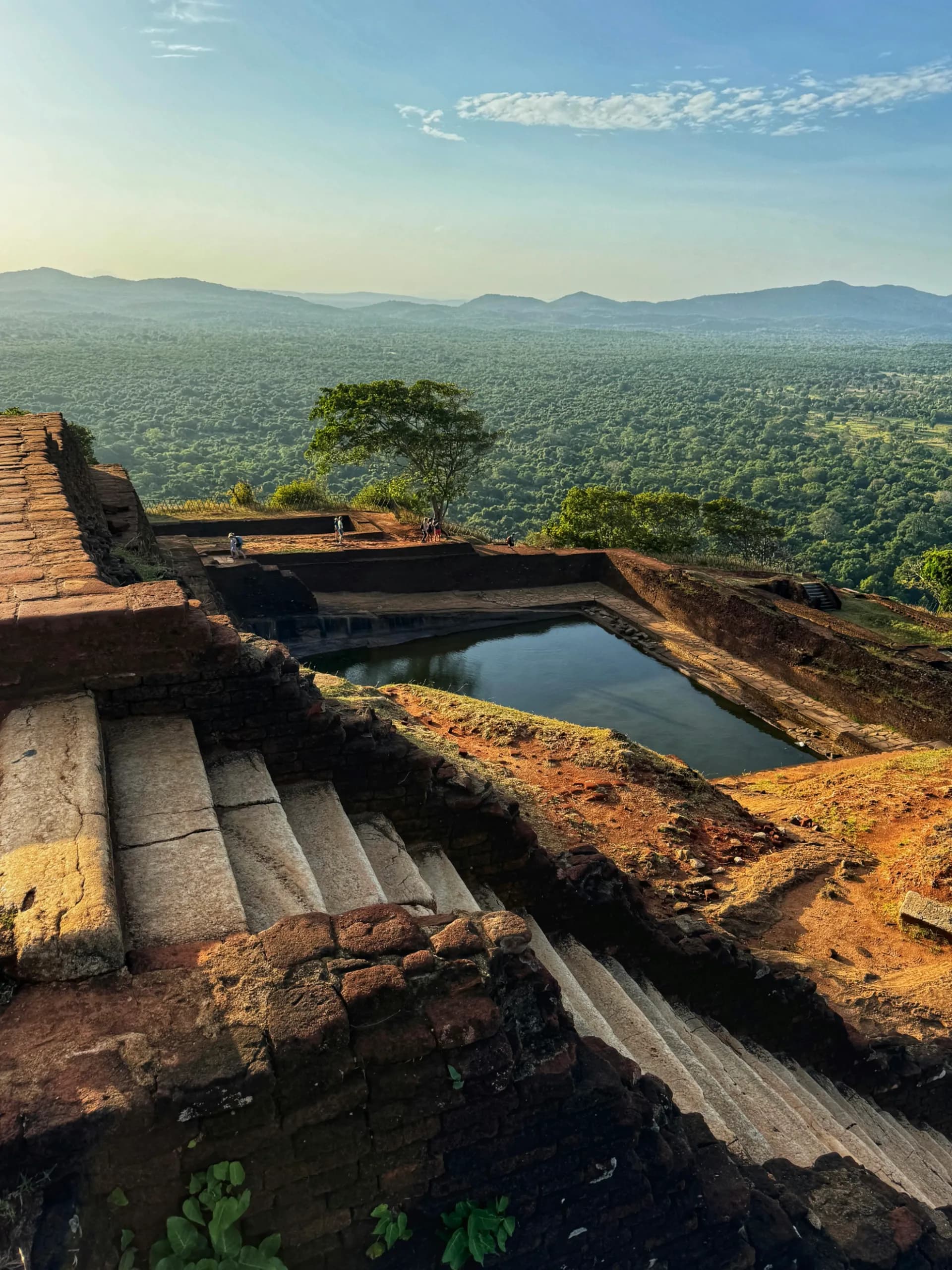
Sigiriya is a two-hundred-metre column of hardened magma standing alone above the jungle, and on top of it are the ruins of a fifth-century royal palace. On the way up you pass water gardens that still work, a wall polished to a mirror finish and covered in ancient graffiti, and a set of frescoes painted into an overhang halfway up the cliff. It is the most visited site in Sri Lanka and, unusually for such a place, it fully deserves the attention.
Key Takeaways
- Sigiriya was built as a royal citadel in the fifth century and abandoned within two decades
- The climb is around 1,200 steps and takes 1.5 to 3 hours including stops
- Start at opening, around 7:00am — the rock is exposed and there is no shade on the stairs
- The frescoes and mirror wall sit halfway up and are the reason to take the main route
- Pidurangala, the neighbouring rock, gives the better photograph of Sigiriya
- The site closes its ticket office well before sunset — do not plan a late afternoon climb
- Combine it with Dambulla Cave Temple, twenty minutes away, on the same day or the next
The Story Behind the Rock
The short version is a family tragedy. In the fifth century King Kasyapa took the throne after killing his father, and, fearing revenge from his exiled brother, moved the capital from Anuradhapura to the top of an isolated rock.
What he built there was not a fort so much as a statement — a palace on the summit, landscaped gardens at the base, frescoes on the cliff face, and an entrance through the mouth and paws of an enormous brick lion, which is where the name comes from. Sinhagiri, lion rock.
He ruled from it for about eighteen years. His brother eventually returned with an army, Kasyapa was defeated, and the capital moved back to Anuradhapura. The site became a Buddhist monastery and then, gradually, was left to the jungle.
What survives is the most complete surviving example of ancient urban planning in Asia, and a UNESCO World Heritage Site since 1982.
What You Actually See on the Way Up
The climb divides into four distinct sections, and it is worth knowing what each one is so you do not walk past the best parts.
The water gardens. At the base, laid out symmetrically on either side of the approach. These are among the oldest landscaped gardens in the world, and the fountains still run in the rainy season using nothing but the original hydraulics.
The boulder gardens and terraces. The path climbs through a jumble of enormous boulders, many with notches cut into them where structures once stood.
The frescoes. A spiral staircase leads up to a sheltered overhang holding the surviving painted figures — women in fine detail, still vivid after fifteen centuries. Photography is not permitted here. Of what may originally have been hundreds, around twenty remain.
The mirror wall. A long polished wall beside the path, originally burnished so highly the king could see himself in it. Visitors between the sixth and fourteenth centuries wrote verses on it, many of them about the women in the frescoes. Those inscriptions are now a significant source for the history of the Sinhala language. Do not add to them.
The lion's paws and the summit. Two vast carved paws flank the final stairway — all that remains of the lion gate. Above them the metal staircase climbs the exposed face to the palace ruins on top, with foundations, a cut-rock throne and a reservoir still visible.
How Hard Is the Climb?
Moderate. It is roughly 1,200 steps, and it is a staircase rather than a scramble, but a few things make it harder than the number suggests.
- The final section is on open metal staircases bolted to the cliff face, which is genuinely uncomfortable if you dislike heights
- There is almost no shade once you leave the boulder gardens
- The steps are uneven and worn in places, particularly on the older stone sections
- It gets congested in the narrow sections, and you move at the pace of the group in front
Most reasonably fit people take an hour to ninety minutes up, with stops. Allow three hours for the whole visit including the gardens and the museum.
If you have vertigo, the frescoes staircase and the upper section will be difficult. Pidurangala, described below, is a better option in that case.
Timing Your Visit
This is the single most important practical decision, and getting it wrong changes the experience completely.
| Start Time | What to Expect |
|---|---|
| 7:00am (opening) | Cool, quiet, best light — the right answer |
| 8:00–9:00am | Still pleasant, tour groups arriving |
| 10:00am–2:00pm | Hot, exposed, crowded, queues on the stairs |
| 3:00–4:00pm | Cooler again, but ticket sales close and the site clears early |
Be at the gate when it opens. By nine o'clock the coach groups have arrived and the narrow upper staircases develop genuine bottlenecks. By eleven the rock face radiates heat and the climb stops being enjoyable.
The site stops selling tickets well before sunset and clears visitors off the summit before dark, so a late afternoon climb is a gamble. Morning is the answer.
Between April and August the heat is a real factor — see our guide to the best time to visit Sri Lanka for how the Cultural Triangle behaves through the year.
Sigiriya or Pidurangala?
Pidurangala is the rock immediately north of Sigiriya, and the question of which to climb comes up constantly. The honest answer is that they are not really alternatives.
| Sigiriya | Pidurangala | |
|---|---|---|
| What you see | Frescoes, mirror wall, palace ruins, gardens | A cave temple, a reclining Buddha, and the view |
| The view | Across the plain in every direction | The view of Sigiriya itself |
| Difficulty | 1,200 steps, staircases, exposed | Shorter but rougher — a boulder scramble at the top |
| Crowds | Busy from mid-morning | Busy at sunrise, quiet otherwise |
| Cost | Significantly higher | A fraction of Sigiriya |
Climb Sigiriya for the site. Climb Pidurangala for the photograph. You cannot photograph Sigiriya while standing on it, and the classic image of the rock rising out of the jungle is taken from Pidurangala.
If you have the time and the legs, do both — Pidurangala for sunrise, then Sigiriya as it opens. It makes for a demanding morning and an excellent one.
Practical Notes
- Bring more water than you think. There is nothing to buy above the boulder gardens.
- Wear proper shoes. Sandals are a genuinely bad idea on worn stone and metal grating.
- Sun protection is essential — hat, sunscreen, and preferably sleeves.
- No photography at the frescoes. This is enforced.
- Wasps are a real hazard. The rock has resident hornet colonies and the site occasionally closes sections because of them. Follow the posted instructions, stay quiet under the marked areas, and do not make sudden noise.
- The museum near the entrance is worth twenty minutes before you climb — it gives the site context you will otherwise miss.
- Guides are available at the entrance. A good one transforms the mirror wall and the frescoes from curiosities into the most interesting part of the visit.
- Monkeys will take food out of an open bag. Keep it closed.
Combining Sigiriya With Dambulla
Dambulla Cave Temple is twenty minutes down the road and pairs naturally with Sigiriya. Five caves cut into a rock face, filled with more than 150 Buddha statues and ceilings painted end to end.
The sensible order is Sigiriya at opening, Dambulla in the afternoon. Dambulla is partly shaded and far more comfortable in the middle of the day, and its own climb to the entrance is short.
Both sit within the Cultural Triangle alongside Polonnaruwa and Anuradhapura. How they fit into a wider route is set out in our 10-day itinerary, with the ancient cities added in the 14-day version.
If you are based on the coast and want Sigiriya as a single long day rather than an overnight stop, we run it as a private day excursion with a chauffeur-guide. The full ancient-cities circuit is covered by our cultural tours.
Where to Stay
Sigiriya village puts you closest to the gate, which matters for a 7:00am start. Options run from simple guesthouses to a handful of well-known hotels with the rock in view.
Habarana is fifteen minutes away and better placed if you are also visiting Minneriya or Kaudulla for the elephants, or heading on to Polonnaruwa.
Dambulla is the practical middle point and generally the best value of the three.
Two nights in this area is right. One night means climbing on the day you arrive after a long drive, which is exactly the wrong way round.
Plan Your Cultural Triangle Stop
With Sigiriya understood, the next steps are fitting it into your route and timing the trip:
- The Perfect 10-Day Sri Lanka Itinerary — where Sigiriya sits in the classic loop
- 14 Days in Sri Lanka: The Complete Itinerary — adds Polonnaruwa and Anuradhapura
- Best Places to Visit in Sri Lanka — the wider destination guide
- Best Time to Visit Sri Lanka — everything in one place