
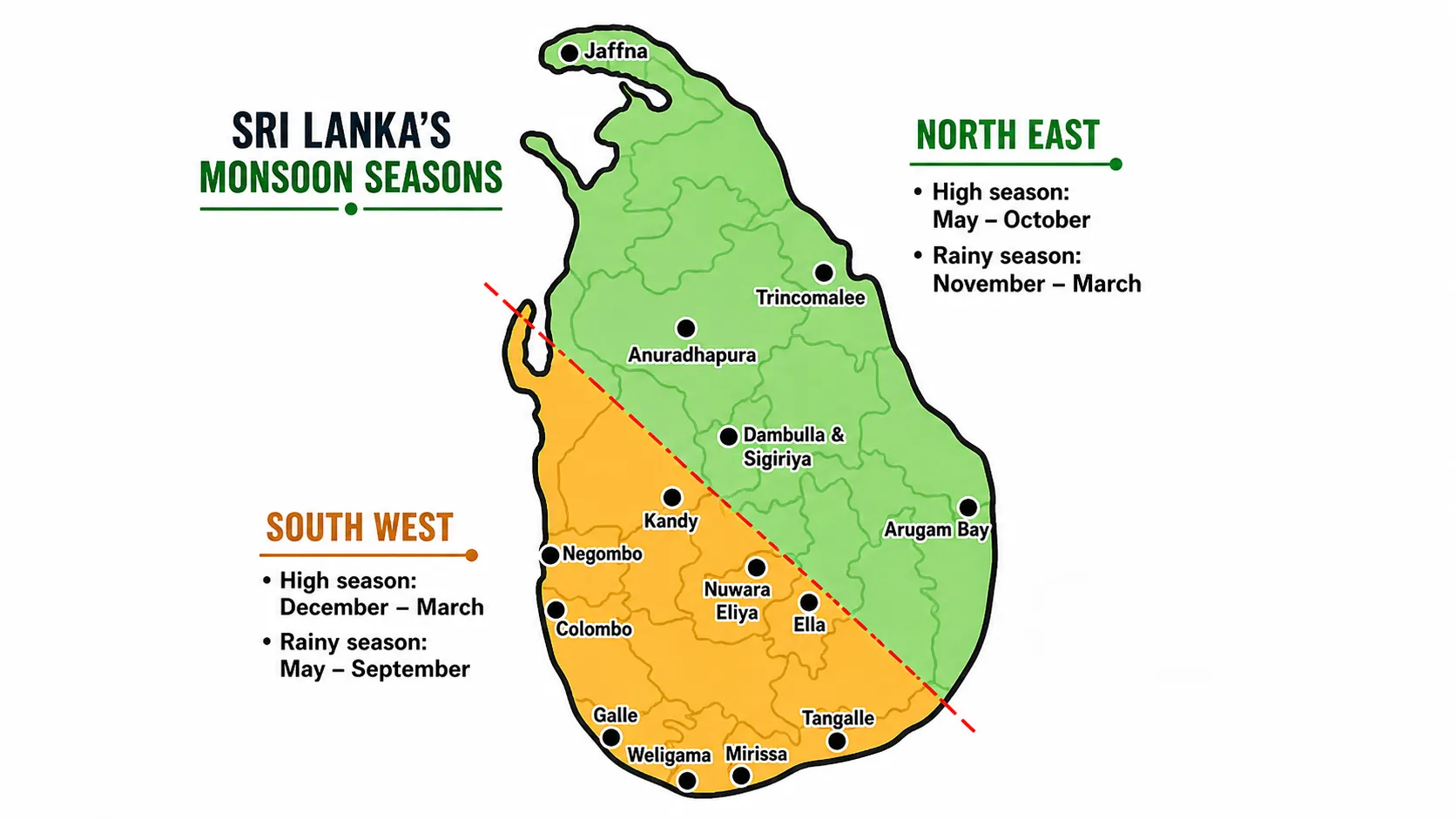
Sri Lanka is one of the few countries where there is no single best time to visit — only a best time to visit each part of it. Two separate monsoons cross the island at opposite ends of the year, so while rain is sweeping one coast the other is usually dry, warm and at its finest. Once that pattern makes sense the whole trip becomes far easier to plan. This guide sets out what to expect month by month, and which regions to pair with which dates.
Key Takeaways
- Sri Lanka has two monsoons, so somewhere on the island is in season every month of the year
- The west coast, south coast and hill country are at their driest from December to March
- The east coast — Trincomalee, Nilaveli and Arugam Bay — is at its best from May to September
- December to March is the busiest period, so accommodation and internal transport need booking well ahead
- October and November are the wettest months island-wide, but also the quietest and greenest
- Whale watching runs November to April off Mirissa and May to September off Trincomalee
- The Adam's Peak pilgrimage season opens in December and closes in May
Sri Lanka Has Two Monsoons, Not One
This is the single most useful thing to understand about the Sri Lankan calendar, and it is the reason so much advice about the country contradicts itself.
The Yala monsoon arrives from the southwest and runs roughly from May to September. It brings rain to the west coast, the south coast and the hill country — the regions most visitors think of as the classic Sri Lanka route.
The Maha monsoon comes from the northeast between October and January and does the opposite, soaking the north and east while the southwest dries out.
Between them sit two inter-monsoon periods, in October–November and again around March–April, when rain can arrive anywhere on the island, usually as short heavy afternoon thunderstorms rather than all-day drizzle.
The practical upshot: you do not need to avoid Sri Lanka at any time of year. You need to choose the right half of the island for your dates.
Month by Month at a Glance
| Month | West and South Coast | Hill Country | East and North | Notes |
|---|---|---|---|---|
| January | Excellent | Excellent | Wet | Peak season, clearest hill country skies |
| February | Excellent | Excellent | Improving | Often the best all-round month |
| March | Excellent | Very good | Good | Warm, still dry, crowds thinning |
| April | Good | Good | Good | Hot; Sinhala and Tamil New Year mid-month |
| May | Turning wet | Turning wet | Very good | East coast season opens |
| June | Wet | Wet | Excellent | Good value in the southwest |
| July | Wet | Mixed | Excellent | Elephant gathering begins inland |
| August | Wet | Mixed | Excellent | Esala Perahera in Kandy |
| September | Improving | Improving | Very good | East coast still strong |
| October | Wet | Wet | Turning wet | Wettest month island-wide |
| November | Improving | Improving | Wet | Whale season opens off Mirissa |
| December | Very good | Very good | Wet | Peak season begins, festive demand |
"Wet" rarely means a washout. Even in monsoon months the rain tends to come in concentrated bursts, and mornings are often clear. It does mean rougher seas, fewer boat trips running, and a real chance of losing an afternoon.
December to March — The Peak Season
If you only take one thing from this guide, take this: December to March is the strongest window for a first trip to Sri Lanka. The southwest is dry, the sea is calm enough for swimming and boat trips, the hill country gives its clearest views, and the Cultural Triangle is comfortable to walk around.
It is also the busiest and most expensive period, and the one that sells out first. Popular beach hotels and the reserved carriages on the hill country trains go months in advance, and the closer you get to Christmas the truer that becomes.
December itself is a month of transition — the northeast monsoon is still finishing over the east while the southwest opens up. For a closer look at what that means on the ground, read our guide to Sri Lanka in December.
Travelling Over Christmas and New Year
The last week of December is the single busiest week of the Sri Lankan tourist year. Hotels along the west and south coasts run festive programmes, restaurants take bookings weeks out, and the roads between Colombo, Bentota and Galle get noticeably heavier.
It is a genuinely lovely time to be here — warm, celebratory and busy in a good-natured way — but it is not a week to improvise. If your dates fall in that window, see our Christmas and New Year guide for what to expect and how far ahead to commit.
The Best Months for Whale Watching
Sri Lanka is one of the most reliable places on earth to see blue whales, and the season follows the monsoons like everything else.
| Departure Point | Season | What You Are Likely to See |
|---|---|---|
| Mirissa (south coast) | November to April | Blue whales, sperm whales, spinner dolphins |
| Trincomalee (east coast) | May to September | Blue whales, sperm whales, occasional orca |
| Kalpitiya (northwest) | December to April | Large spinner dolphin pods, some whales |
Peak conditions off Mirissa fall between December and March, when the sea is calmest and sightings are at their most consistent. Full detail on choosing an operator and what the morning actually involves is in our whale watching guide.
When to Climb Adam's Peak
Adam's Peak has a defined pilgrimage season that has nothing to do with the tourist calendar. It opens on the Unduvap full moon in December and closes at Vesak in May.
Inside that window the stairway is lit through the night, tea stalls are open along the route, and thousands of pilgrims climb in the dark to reach the summit for sunrise. Outside it the path is unlit, the shelters are closed and the ascent is genuinely risky.
Weekends and full moon days inside the season are extremely busy — a weekday climb is far more comfortable. Our Adam's Peak guide covers timing the ascent, what to wear and how hard it actually is.
Beach Season on the South Coast
The stretch from Bentota down through Galle to Mirissa and Tangalle is at its best from December to March, when the sea flattens out and the sand is at its widest. This is when the south coast looks the way it looks in photographs.
From May the southwest monsoon turns the same beaches choppy and grey, and many of the smaller places close for the season. Surfers are the exception — the beginner breaks at Weligama and Hikkaduwa work best in the drier months, while experienced surfers move across to Arugam Bay in the middle of the year.
For a beach-by-beach breakdown of where to base yourself, read our south coast beaches guide.
May to September — The East Coast Season
While the southwest is under monsoon, the east is at its finest. Trincomalee, Nilaveli, Pasikuda and Arugam Bay all come into season around May and hold it until September.
This is worth knowing if your dates are fixed by school holidays or work and land squarely in the European summer. A July or August trip is not a compromised trip — it is simply a different route, weighted towards the east coast, the Cultural Triangle and the inland national parks, where the dry season concentrates elephants around the reservoirs.
It is also when Kandy holds the Esala Perahera, the largest festival in the country.
Wildlife Seasons Worth Planning Around
Wildlife has its own calendar, and in several cases it runs opposite to the beach season.
| Experience | Best Months | Where |
|---|---|---|
| Leopard sightings | February to July | Yala National Park |
| The elephant gathering | July to September | Minneriya and Kaudulla |
| Blue whales | December to March | Mirissa |
| Endemic birds | December to April | Sinharaja rainforest |
| Sea turtle nesting | Year round, peaks March to July | Rekawa and Kosgoda |
Yala is at its most rewarding late in the dry season, when water is scarce and animals concentrate around the remaining waterholes. Note that the main block traditionally closes for several weeks around September for maintenance.
How Long Should You Stay?
The honest answer is that Sri Lanka is small but slow. Distances look short on a map and take much longer than expected on winding hill roads.
| Trip Length | What Fits Comfortably |
|---|---|
| 7 days | One region done properly — either the cultural loop or the south coast |
| 10 days | The classic circuit: Cultural Triangle, Kandy, hill country, one park, one beach |
| 14 days | The same circuit unhurried, plus the east coast or the far south |
| 3 weeks | Adds the north, Jaffna, and time to stop moving altogether |
Ten days is the sweet spot for most first visits — enough to see the range of the island without spending every other morning in a vehicle. Our 10-day Sri Lanka itinerary sets out that route day by day, and the 14-day itinerary shows what the extra four days buy you.
The Best Time for a Honeymoon
Honeymoon travel concentrates in the December to March window for the obvious reason that it lines up with calm seas and dry beach weather in the southwest.
February in particular tends to be the strongest single month — reliably dry, slightly past the Christmas rush, and warm without the heat that builds through April. If you would rather trade a little weather certainty for quieter beaches and better availability, late March and early April are worth considering.
Our Sri Lanka honeymoon guide covers where to combine hill country and coast, and how long to give each.
When to Visit Sigiriya and the Cultural Triangle
The Cultural Triangle sits in the dry zone, which makes it far less monsoon-dependent than either coast. Sigiriya, Dambulla, Anuradhapura and Polonnaruwa can be visited comfortably for most of the year.
Timing here is about heat and light rather than rain. From April to August the middle of the day on an exposed rock face is genuinely punishing, so the climb is best started at opening or late in the afternoon. Between December and March the same climb is a pleasure at almost any hour.
Our Sigiriya guide covers the climb, the best time of day to start, and how to combine it with Dambulla and Pidurangala.
Ready to Plan Your Trip?
The right dates depend less on the calendar than on what you want out of the trip — beaches, wildlife, hill country or festivals. Get the region and the month matched up, book the peak-season pieces early, and Sri Lanka rewards you in almost any month of the year.
If you would rather not assemble it yourself, our tailor-made tours are built around your dates and interests, and our tour categories show the routes we run most often through each season.