
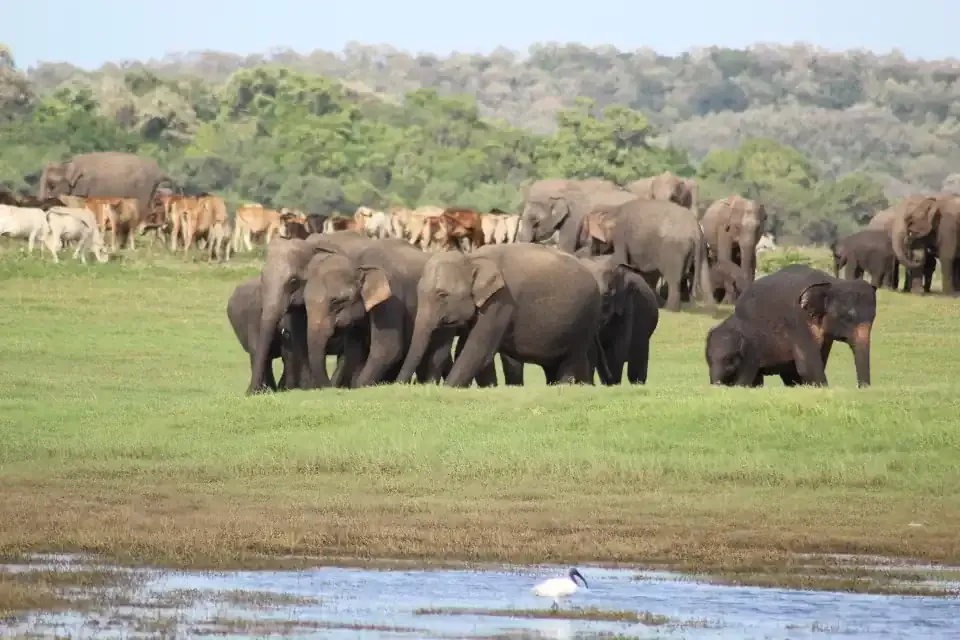
A Sri Lanka wildlife safari is most rewarding when animals have the space to behave naturally. The best sightings — the ones you remember for years — rarely come from chasing, crowding, or rushing. They come from patience, from a good tracker who reads the landscape, and from the simple discipline of staying still and letting the wildlife come to you. This guide covers how to plan a safari that is both genuinely rewarding and genuinely responsible.
Key Takeaways
- Patient observation at respectful distance consistently produces better sightings than aggressive pursuit
- Sri Lanka has one of the highest leopard densities in Asia — Yala National Park is world class
- The Minneriya Gathering (roughly July–October) is one of the great wildlife spectacles on Earth
- Choosing a responsible operator with an experienced tracker is the single most important safari decision
- No flash photography near any wildlife — it causes stress and disrupts natural behaviour
- Responsible tourism directly supports conservation funding for Sri Lanka's national parks
- Wildlife behaves most naturally at dawn — the early morning game drive is always worth the early start
Why Responsible Safari Matters in Sri Lanka
Sri Lanka's wildlife is extraordinary — and under pressure. Development has reduced natural habitat, increased human-wildlife conflict, and put growing stress on national park ecosystems. Tourism is both part of the problem and a significant part of the solution.
When done well, wildlife tourism generates conservation funding, creates economic reasons to protect habitat, and builds international awareness that supports long-term preservation. When done badly — jeeps crowding around a leopard, flash photography near elephants, off-road driving in sensitive areas — it adds to the pressure on already stressed animals.
The good news is that responsible practice and a rewarding safari are the same thing. Animals that are not stressed by people behave naturally. Natural behaviour is what produces the sightings worth having.
Understanding Sri Lanka's Wildlife
The Sri Lankan Leopard
The Sri Lankan leopard (Panthera pardus kotiya) is a subspecies found only on this island. Yala National Park's Block 1 has one of the highest densities of leopards relative to land area anywhere in the world, making Sri Lanka one of the best places on Earth for leopard sightings.
Responsible leopard watching:
- Never pressure your driver to move closer than the animal is comfortable with
- If a leopard is resting, wait quietly — do not rev the engine or make noise to get it to move
- A leopard that feels safe will stay visible far longer than one that feels threatened
- If your jeep is the fifth to arrive at a sighting, consider moving on — crowding is one of the most damaging habits in Sri Lanka safari tourism
The Asian Elephant
Sri Lanka has several thousand wild elephants. They are intelligent, socially complex animals with long memories and strong family bonds. Encounters with wild elephants are among the most moving experiences Sri Lanka offers — and among the most easily spoiled by poor behaviour.
Responsible elephant watching:
- Keep a generous distance — your tracker will judge it, but 50 metres is a sensible guide
- Never position your jeep between a mother and her calf
- If an elephant shows signs of agitation — raised trunk, flared ears, mock charging — ask your driver to reverse slowly and quietly
- Never feed elephants — it habituates them to people and creates dangerous dependency
- Even at the Minneriya Gathering, distance and patience produce the best experience
The Sloth Bear
One of Sri Lanka's most elusive large mammals — slow-moving, poor-sighted, and easily startled. Sloth bear encounters need calm, quiet behaviour from everyone in the jeep.
Responsible sloth bear watching:
- Complete silence when a sloth bear is sighted
- No sudden movements or long camera bursts
- A startled sloth bear can be more dangerous than a leopard — keep your distance
Bird Life
Sri Lanka has over 400 recorded bird species, including more than 30 found nowhere else on Earth. Even casual visitors are struck by the variety visible on any game drive.
Responsible bird watching:
- Avoid playing recorded bird calls to attract species — it stresses territorial birds
- Wetland areas like Bundala are particularly sensitive — stay on designated tracks
Choosing a Responsible Safari Operator
Your operator is the most important decision you make for both the quality and the ethics of your safari. A responsible operator:
Has experienced, knowledgeable trackers. A good tracker reads animal behaviour, knows individual animals, and understands when to approach and when to hold back. They also keep passengers' behaviour in check — that is part of the job.
Maintains their vehicles properly. Well-maintained jeeps do not break down inside the park, do not need noisy jump-starts, and do not leak oil into sensitive ecosystems.
Respects park rules. No off-road driving, no feeding wildlife, no excessive noise, no crowding sightings. These are park regulations, not just good manners.
Is transparent about pricing. A clear breakdown of park fees, tracker costs, and vehicle charges. Vague pricing often means corners are being cut somewhere.
Questions to ask before booking:
| Question | What a Good Answer Looks Like |
|---|---|
| How experienced is our tracker? | Specific years of experience, a named individual |
| Which part of the park will we visit? | A specific answer — for Yala, usually Block 1 |
| What do you do at a crowded sighting? | Move on rather than add to the crowd |
| How are your vehicles maintained? | Regular servicing, a clear answer |
| What is included in the price? | An itemised breakdown of all costs |
For full details on Sri Lanka's best national parks and what to expect on a game drive read our Sri Lanka Safari Guide.
Responsible Safari Practices — The Complete Guide
Before You Enter the Park
- Brief your group on responsible behaviour — children especially benefit from knowing what is expected
- Charge your camera the night before so you are not asking the driver to wait
- Pack out everything you bring in — no rubbish left in the park
- Wear neutral colours — bright clothing is unnecessary and can be disruptive
During the Game Drive
Stay in the vehicle unless your tracker tells you otherwise at a designated area. It is a safety rule and a wildlife rule — your scent on the ground changes animal behaviour long after you leave.
Keep voices low. Sound carries in national parks. The quieter your jeep, the more you will see.
Follow your tracker's lead. If they say stop, stop immediately and quietly. If they say reverse, do not argue. They are reading body language you may not notice.
Do not pressure your driver for closer access. A leopard that feels safe at 30 metres may stay in view for 20 minutes. A leopard that feels crowded at 10 metres will disappear in seconds.
Photography — Responsible Practice
Photography is one of the great pleasures of safari and fully compatible with responsible practice.
No flash photography. Ever, near any animal. Flash causes stress and disrupts natural behaviour. This applies to phones too — turn off auto-flash before you enter the park.
Use burst mode with restraint. Rapid shutter clicks are audible at close range. Use bursts for action, not near resting animals.
Never bait or lure wildlife. Placing food to attract animals is harmful, unethical, and prohibited in Sri Lanka's national parks.
The best wildlife photographs come from patience, not pursuit. Position well, wait quietly, and let the animal move into natural light on its own.
Photography Settings for Sri Lanka Wildlife
| Situation | Starting Settings |
|---|---|
| Leopard in dappled shade | f/2.8, 1/500 sec, ISO 800–1600, continuous AF |
| Elephant herd at water | f/5.6, 1/250 sec, ISO 400, wide angle |
| Birds in flight | f/4, 1/1000 sec+, ISO 800, continuous AF |
| Dawn game drive | f/2.8, 1/250 sec, ISO 1600–3200 |
| Golden hour | f/4, 1/500 sec, ISO 400, warm white balance |
The Ethics of Elephant Encounters Beyond Safari
Sri Lanka also offers elephant encounters outside national parks — orphanages, camps, and in some places elephant rides. These vary enormously in how responsibly they are run.
What responsible elephant encounters look like:
- Observation only — watching elephants in natural or semi-natural surroundings without physical contact
- Rehabilitation centres where interaction is controlled and welfare comes first
- The Elephant Transit Home at Udawalawe — a government-run rehabilitation centre where visitors watch feeding sessions from a viewing area
What to avoid:
- Elephant rides — training elephants to carry riders involves practices that cause real suffering
- Elephant painting or tricks — these rely on the same training methods
- Bathing or contact experiences in unregulated settings
- Chains and hooks — any facility keeping elephants permanently chained or using bull hooks is not operating responsibly
A simple test: if an elephant is doing something it would not naturally do in the wild — carrying a person, painting, performing — the training behind it was not humane.
What Responsible Safari Gives You
Beyond the ethics, responsible practice simply produces better experiences.
More sightings. Animals that are not stressed stay visible longer. A leopard that feels safe will groom, stretch, yawn and scan its territory — behaving like a leopard, not like an animal trying to escape.
Better photographs. Natural behaviour in good light beats a stressed animal at close range every time.
A richer experience. Sitting quietly in a park at dawn, listening to the ecosystem wake up, watching a herd move through early light — this is what safari is really about. The jeep that races between sightings misses all of it.
Support for conservation. Every responsible booking contributes to park funding, tracker livelihoods, and the economic case for protecting habitat. Your visit, done well, is part of the solution.
When to Go for the Best Wildlife Experiences
| Month | Yala | Minneriya | Udawalawe | Notes |
|---|---|---|---|---|
| January | Good | Fewer elephants | Excellent | Dry season beginning |
| February – April | Excellent | Fewer elephants | Excellent | Great all-round window |
| May – July | Very good | Gathering building | Excellent | Strong months for Yala |
| August | Good | Gathering near peak | Excellent | Often Kandy Perahera season too |
| September | Usually closed for part of the month | Peak gathering | Excellent | Minneriya at its best |
| October – December | Reopens | Gathering ends | Good | Wet season begins |
Yala usually closes for a few weeks each year around September and October — always check current closure dates before you plan.
August is a particularly good month to combine experiences. Minneriya's gathering is building, Yala is still open, and the Kandy Esala Perahera usually falls in July or August. One trip can combine world-class wildlife with one of Asia's greatest festivals — just confirm the festival dates for your year.
Planning Your Responsible Safari
A responsible and rewarding Sri Lanka safari comes down to three things: the right operator, a group that understands how to behave, and patience as your main tool.
Wildlife does not perform on schedule. The best encounters happen when you stop expecting them and simply pay attention. That mindset — open, patient, respectful — is what separates a good safari from an extraordinary one.
- Sri Lanka Safari Guide — parks, logistics, what to expect on a game drive
- Best Places to Visit in Sri Lanka — combining wildlife with the rest of your journey
- Where to Start in Sri Lanka — heritage, wildlife, tea country or coast
- Kandy Esala Perahera Complete Guide — combine safari with Sri Lanka's greatest festival