
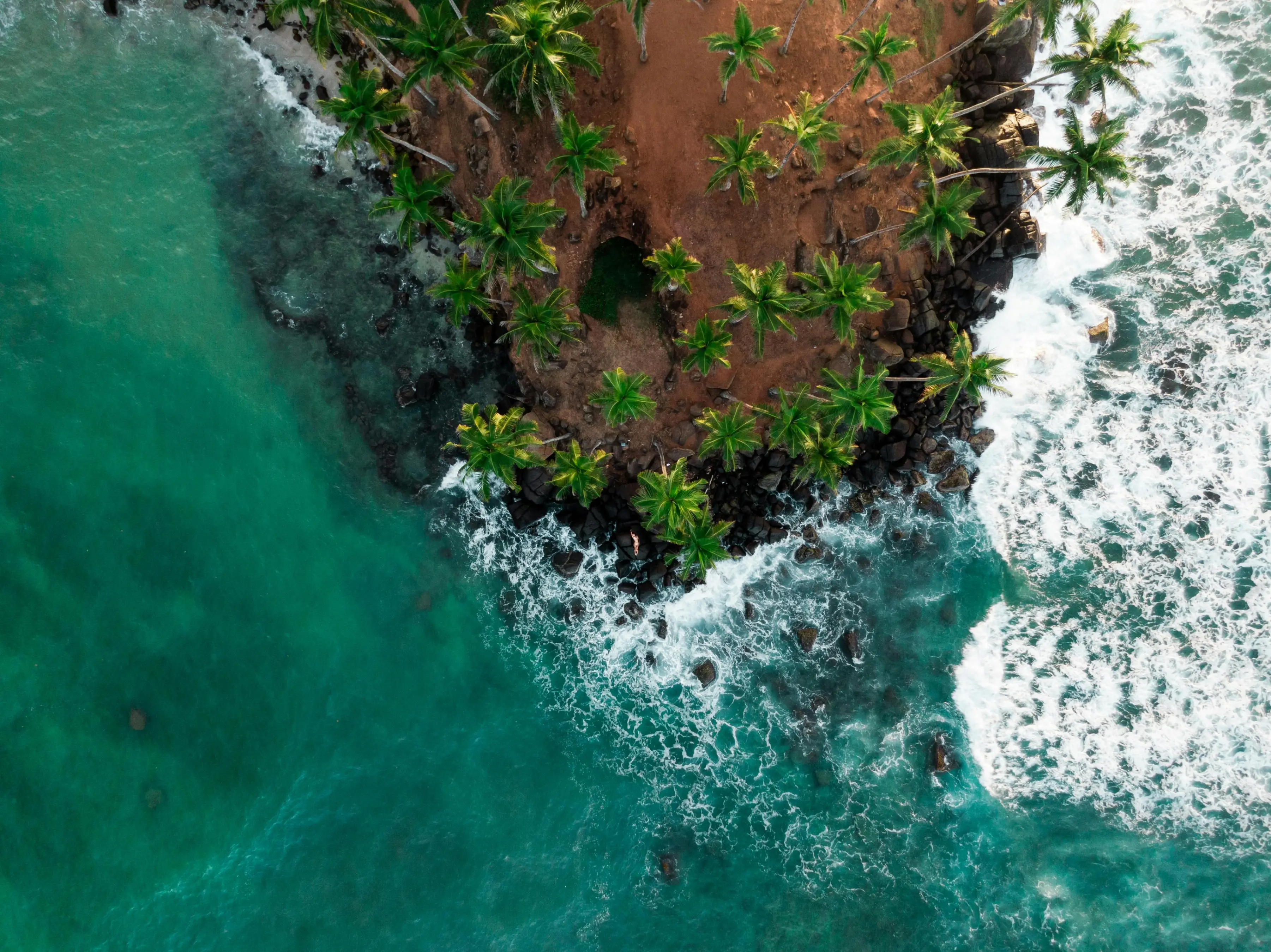
Sri Lanka's south coast runs for roughly 150 kilometres of headlands, river mouths and palm-backed bays, and no two stretches of it are alike. One town is a surf break with a dozen guesthouses, the next a sheltered swimming bay full of families, the next a wide empty sweep with a single hotel behind it. Choosing well matters more here than almost anywhere else in the country. This guide covers what each place is actually like and who it suits.
Key Takeaways
- The south coast season runs December to April, at its best from December to March
- From May to September the southwest monsoon makes the same beaches rough and grey
- Bentota and Unawatuna are the most sheltered for swimming; Tangalle is the wildest
- Weligama and Hikkaduwa are where most people learn to surf
- Mirissa is the base for whale watching and has the liveliest evenings
- Rip currents are a real risk — swim where other people are swimming
- Distances are short but road journeys are slow; budget an hour for 40 kilometres
The Season Decides Everything
Before choosing a beach, get the timing right. The south coast is transformed by the southwest monsoon.
| Months | Conditions | Verdict |
|---|---|---|
| December to March | Calm, clear, wide beaches | The best of the year |
| April | Warm, mostly calm, hotter | Very good, quieter |
| May to September | Rough sea, strong winds, rain | Poor for swimming |
| October to November | Improving, unsettled | Mixed, but quiet and green |
In monsoon months many smaller guesthouses and beach restaurants close entirely, and swimming is unsafe on the exposed stretches. The east coast takes over as the beach destination during that period.
For the full picture of how the two coasts trade places through the year, see our guide to the best time to visit Sri Lanka.
The Beaches, West to East
Bentota — Best for Families and Calm Water
The most developed resort stretch on the coast, sitting on a spit between the sea and the Bentota River. Water sports operate out of the river mouth, the beach is long and gently shelving, and the hotel choice is the broadest anywhere on the coast.
Best for: families, first-time visitors, anyone who wants facilities on the doorstep Trade-off: it feels like a resort rather than a village Nearby: Madu River boat safari, Kosgoda turtle hatchery
Hikkaduwa — Best for Reef and Beginner Surf
A long-standing traveller town with a shallow reef close to shore, decent snorkelling, and a well-established surf scene aimed at beginners and improvers. Busier and noisier than most of the coast.
Best for: snorkelling, learning to surf, evenings out Trade-off: the main road runs right behind the beach Nearby: turtle hatcheries, coral sanctuary
Unawatuna — Best for Sheltered Swimming
A curved, sheltered bay just around the headland from Galle, and one of the few places on the coast where the water is calm enough to swim comfortably almost all season. Popular, and it feels it.
Best for: easy swimming, proximity to Galle, walkable dining Trade-off: the beach is narrow and gets crowded Nearby: Galle Fort, Jungle Beach, Japanese Peace Pagoda
Galle — Best as a Base Rather Than a Beach
Galle itself is not a beach town. What it is, is the most interesting place to stay on the entire coast — a walled Dutch fort with cafés, galleries and boutique hotels inside the ramparts, and sunset walks along the walls.
Best for: history, architecture, food, rainy afternoons Trade-off: you drive to swim Nearby: Unawatuna, Jungle Beach, Koggala
Ahangama and Midigama — Best for Surfers and Quiet
A string of small breaks and low-key places to stay, increasingly the choice of visitors who want the coast without the crowds. Surfing is the organising principle here, but it is also simply a quieter stretch of coastline.
Best for: intermediate surfers, longer stays, a slower pace Trade-off: limited dining, less to do if you do not surf Nearby: stilt fishermen, Koggala Lake
Weligama — Best for Learning to Surf
A wide, shallow bay with a long sandy bottom and a gentle, forgiving break — the reason nearly every surf school on the coast teaches beginners here. The town itself is workaday rather than pretty.
Best for: first-time surfers, long beach walks Trade-off: the bay is busy with surf schools at peak times Nearby: Taprobane Island, Mirissa
Mirissa — Best for Whale Watching and Evenings
A crescent bay with a headland at one end, a working fishing harbour, and the departure point for the south coast whale watching fleet. Livelier after dark than anywhere else on this list.
Best for: whale trips, sunsets from Coconut Tree Hill, nightlife Trade-off: the beach is busy and the bars run late Nearby: Weligama, Polhena reef
Whale season here runs from November to April — the practicalities are covered in our whale watching guide.
Tangalle — Best for Space and Quiet
The coast opens out east of Tangalle into long, wild, often nearly empty beaches backed by palms. Some are unswimmable in swell; the sheltered pockets are superb. This is where the coast's quieter villas and small luxury properties are.
Best for: privacy, honeymoons, doing very little Trade-off: you need transport, and some beaches have dangerous surf Nearby: Rekawa turtle beach, Mulkirigala rock temple
Hiriketiya — Best Small Bay
A near-perfect horseshoe bay just around from Dickwella, with a gentle inside break for beginners and a punchier one on the point. It became popular quickly and now has a cluster of good cafés behind the sand.
Best for: surfing and swimming in one small bay, café culture Trade-off: small, and it fills up
Which Beach Should You Choose?
| If You Want | Go To |
|---|---|
| Calm water and family facilities | Bentota or Unawatuna |
| To learn to surf | Weligama or Hikkaduwa |
| Whale watching and lively evenings | Mirissa |
| Quiet, space and privacy | Tangalle |
| History and good food | Galle |
| A slower surf town | Ahangama or Hiriketiya |
Swimming Safety
This deserves more attention than it usually gets. Rip currents cause drownings on this coast every year, and most involve visitors.
- Swim where other people are swimming. An empty beautiful beach is often empty for a reason.
- Very few beaches have lifeguards, and those that do only staff them in season.
- Ask at your guesthouse which end of the local beach is safe — they will know precisely.
- If caught in a rip, swim parallel to the shore rather than against the pull.
- Conditions change with the tide, so a bay that was calm in the morning may not be at five o'clock.
Getting Around the Coast
The southern expressway makes the run from Colombo or the airport down to Galle far quicker than it used to be. Once you are on the coast, though, the old coastal road is slow, winding and busy.
| Route | Approximate Time |
|---|---|
| Airport to Bentota | 1.5–2 hours |
| Airport to Galle | 2.5–3 hours |
| Galle to Mirissa | 1 hour |
| Mirissa to Tangalle | 1–1.5 hours |
| Galle to Yala | 3–3.5 hours |
Tuk tuks handle short hops well. For anything longer, or with luggage, a private vehicle saves a great deal of time — our transportation fleet covers everything from a sedan to a coach with a chauffeur-guide.
Surfing, diving, snorkelling and the Madu River boat safari are all bookable through our leisure activities, and we hand-pick accommodation along this whole stretch of coast.
How Many Nights on the Coast?
Most visitors underestimate this and end up rushing. Three nights in one place is the minimum for the coast to do its job; five is better.
Splitting between two bases works well on a longer trip — a few nights somewhere lively like Mirissa, then a few somewhere quiet like Tangalle. Our 10-day Sri Lanka itinerary builds the coast in at the end, which is the right order after the driving-heavy inland stretch.
Plan Your Coast Stay
With a beach chosen, the next steps are timing the trip and fitting the coast into your route:
- The Perfect 10-Day Sri Lanka Itinerary — where the coast fits
- Whale Watching in Sri Lanka — from Mirissa, November to April
- Sri Lanka in December — when the coast season opens
- Best Time to Visit Sri Lanka — everything in one place