
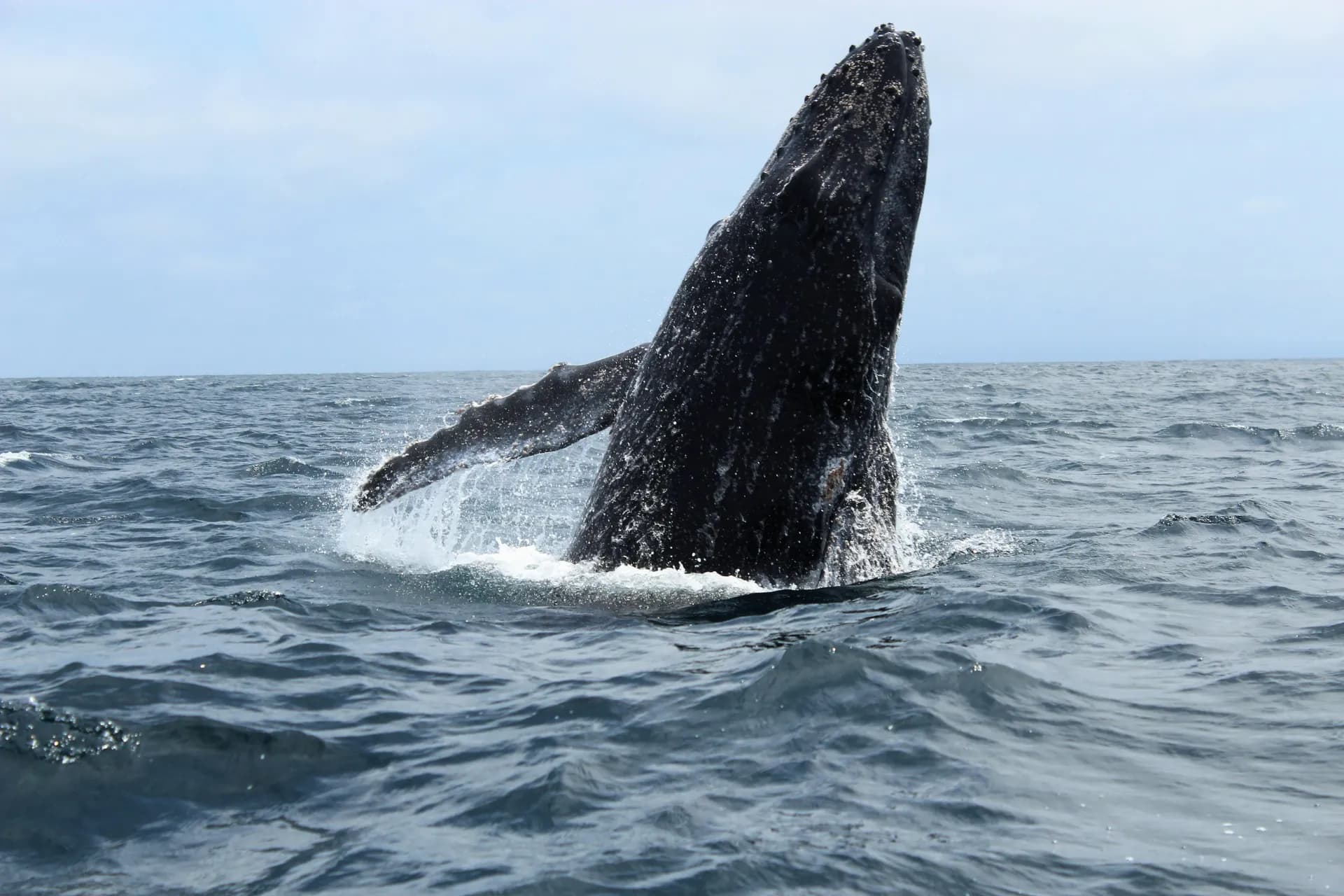
Sri Lanka sits beside one of the deepest continental shelves in the Indian Ocean, which puts the largest animal that has ever lived within a short boat ride of the shore. Blue whales pass close to the island on their migration, and unlike most whale-watching destinations you can be back on land by lunchtime. It is one of the most reliable places on earth to see them — provided you go in the right season, from the right coast, with the right operator.
Key Takeaways
- Mirissa on the south coast runs from November to April, with the calmest seas December to March
- Trincomalee on the east coast runs from May to September — the exact opposite window
- Blue whales are the headline sighting, alongside sperm whales and large spinner dolphin pods
- Boats leave very early, usually between 6:00am and 7:00am, and are out for three to five hours
- Sightings are common but never guaranteed — treat it as wildlife, not a show
- Seasickness is the most common complaint — take something before boarding, not after
- Choose an operator by its distance policy, not by the size or speed of its boat
When and Where to Go
The two main departure points run in opposite seasons, which between them cover most of the year.
| Departure Point | Season | Peak Months | Typical Sightings |
|---|---|---|---|
| Mirissa (south) | November to April | December to March | Blue whales, sperm whales, spinner dolphins |
| Trincomalee (east) | May to September | June to August | Blue whales, sperm whales, occasional orca |
| Kalpitiya (northwest) | December to April | January to March | Large dolphin pods, some whales |
Mirissa is the best known and the busiest. The continental shelf sits unusually close to shore here, so the run out to the whales is shorter than at most whale-watching destinations worldwide.
Trincomalee is quieter, and the water off Swami Rock drops away steeply enough that whales are sometimes visible from land. If your trip falls between May and September this is the one to plan around — it is not a fallback.
Kalpitiya is primarily a dolphin destination. Pods of several hundred spinner dolphins are common, with whale sightings a bonus rather than the expectation.
For how the whale season fits into the wider travel calendar, see our guide to the best time to visit Sri Lanka.
What You Are Likely to See
Blue whales are the reason most people come. They are present off Sri Lanka year-round but concentrate seasonally, and what you typically see is a long blue-grey back rolling through the surface, a tall vertical blow, and — if you are lucky — the tail fluke as the animal dives. They are enormous in a way that photographs never quite convey.
Sperm whales travel in loose groups and are seen fairly regularly, particularly off Trincomalee.
Spinner dolphins are almost guaranteed on any trip, often in pods of several hundred, and they will ride the bow wave if the boat slows.
Bryde's whales, pilot whales and occasionally orca turn up less predictably.
A realistic expectation for a morning off Mirissa in peak season is one or two blue whale encounters and a large dolphin pod. Some mornings deliver far more. Some deliver nothing at all, and any operator promising otherwise is not being honest with you.
What a Morning Actually Involves
It is an early start and a longer trip than most people expect.
| Time | What Happens |
|---|---|
| 5:30am | Hotel pickup, or make your own way to the harbour |
| 6:00–6:30am | Boarding, safety briefing, harbour departure |
| 7:00–8:00am | Transit out to the shelf edge, roughly an hour |
| 8:00–10:30am | Searching and observing |
| 11:00am–12:00pm | Return to harbour |
Boats vary from small local craft to larger double-deck vessels. Bigger is not automatically better — larger boats are more stable in swell but slower to reposition, while smaller boats are more responsive but considerably rougher.
Choosing an Operator Responsibly
This is the part that matters most, and the part most guides skip.
Whale watching off Mirissa grew very quickly, and at its busiest a single whale can attract a crowd of boats. Vessels that crowd, chase or cut across an animal's path cause real disturbance, and the behaviour is easy to spot once you know to look for it.
Ask before you book:
- "What distance do you keep from the whales?"
- "How many boats do you operate, and how many passengers per boat?"
- "What do you do if another boat is already with an animal?"
- "Do you guarantee sightings?" — the right answer is no
Good signs: a stated minimum approach distance, engines idled rather than repeatedly repositioned, a naturalist on board, a willingness to leave an animal alone when other boats arrive, and honesty about the odds.
Warning signs: guaranteed-sighting marketing, boats racing each other to a blow, approaching from directly ahead or behind, and overloaded decks where nobody can move.
The best operators will tell you plainly that you might see nothing. That honesty is the single most reliable quality signal available to you.
Avoiding Seasickness
More trips are ruined by seasickness than by poor sightings. The sea off Mirissa is calmest between December and March, but even then there is a long swell once you pass the headland.
What actually helps:
- Take medication the night before or at least an hour before boarding. Taken once you feel unwell, it does very little.
- Sit low and central, towards the middle of the boat, where movement is least.
- Stay on deck and watch the horizon. Going below or looking at a phone screen makes it worse quickly.
- Eat something light beforehand. An empty stomach is not the safer option.
- Choose the calmest months if you know you are susceptible — December to March off Mirissa.
What to Bring
- Sun protection — there is little shade and the reflection off the water is fierce
- A light windproof layer, since it is cool at speed even in a Sri Lankan summer
- Water and a small snack
- Seasickness medication, taken in advance
- A camera with a zoom, but do not spend the whole encounter behind it
- A dry bag or waterproof pouch for your phone
Combining It With the Rest of Your Trip
Mirissa sits neatly on the classic southwest route, which makes a whale trip easy to slot in without rearranging anything.
Base yourself in Mirissa, Weligama or Tangalle for two nights, take the boat on the first morning, and keep the second morning free as a weather reserve. Trips are cancelled for sea conditions with little notice, and having a spare day turns a cancellation from a disaster into an inconvenience.
Yala and Udawalawe are both within reach of the same stretch of coast, so a whale morning and a park safari pair naturally within a few days of each other. Both are built into our 10-day Sri Lanka itinerary.
We arrange whale watching as part of our leisure activities, alongside diving at Pigeon Island and the south coast surf breaks, and the parks themselves through our wildlife tours.
Plan Your Whale Watching Trip
With the season and the coast decided, the next steps are choosing where to base yourself and when to travel:
- The Best Beaches on Sri Lanka's South Coast — where to stay near Mirissa
- Sri Lanka in December — the month the southern season opens
- The Perfect 10-Day Sri Lanka Itinerary — how a whale morning fits the wider route
- Best Time to Visit Sri Lanka — everything in one place